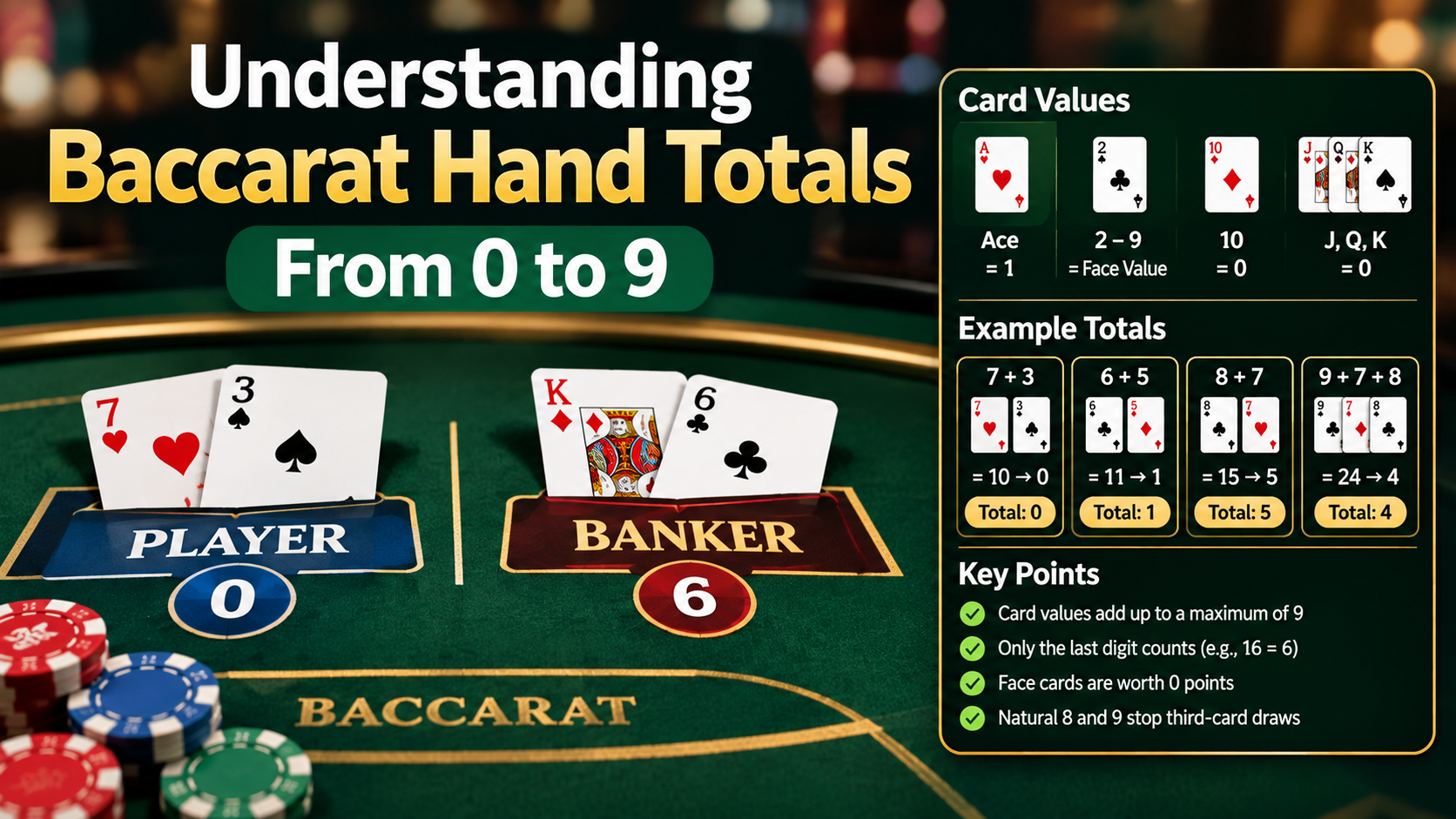
Understanding Baccarat Hand Totals From 0 to 9

September 16, 2026
Baccarat is often described as one of the simpler casino card games, but understanding its scoring system is essential before looking at the outcome of a hand. Unlike blackjack, baccarat does not try to reach a target such as 21. Instead, the goal is to have a hand total closer to 9 than the opposing hand.
The scoring system becomes easy once you understand the value of each card and the way baccarat handles totals above 9. Every completed hand has a final value from 0 to 9, regardless of whether it contains two or three cards.
How Baccarat Card Values Work
The first step in understanding baccarat hand totals is knowing the value assigned to each card.
The standard values are:
- Ace = 1 point
- 2 through 9 = face value
- 10, Jack, Queen and King = 0 points
Suits do not affect the value of a card. This means a 7 is always worth 7 points, while a King contributes zero points to the hand.
For example, a hand containing an Ace and a 6 has a total of 7. A hand containing a 10 and a 5 has a total of 5 because the 10 contributes zero.
This scoring system is the foundation for calculating every baccarat hand.
Why Baccarat Totals Only Range From 0 to 9
The most distinctive part of baccarat scoring is what happens when the combined card values reach 10 or more.
Only the last digit of the total is used as the final hand value.
For example:
- 6 + 2 = 8
- 7 + 3 = 10 → final value is 0
- 8 + 5 = 13 → final value is 3
- 9 + 7 = 16 → final value is 6
- 6 + 7 + 8 = 21 → final value is 1
In other words, the tens digit is ignored. This is why every baccarat hand ends with a value between 0 and 9.
Once this rule is understood, baccarat totals become much easier to calculate.
Understanding Baccarat Hand Totals From 0 to 9
Each final total has the same basic meaning: it represents the last digit of the hand’s combined card values.
Total 0
A baccarat hand can finish with a total of 0 in several ways. For instance, a 10 and a King both have a value of zero, producing a final total of 0.
A 7 and a 3 also produce 10, which becomes 0 after the tens digit is removed.
Total 1
A total of 1 can come from an Ace combined with a zero-value card, such as a King. It can also result from a larger combination such as 6 + 5 = 11, which becomes 1.
Total 2
A 2 and a zero-value card produces 2. Other combinations can also result in 12, 22, or another number ending in 2.
Total 3
A 3 combined with a zero-value card gives a total of 3. A 7 and 6 produces 13, which is scored as 3.
Total 4
A hand such as 4 and a King produces 4. A combination that adds up to 14 will also have a final baccarat value of 4.
Total 5
A 5 and a 10 results in 5 because the 10 has no point value. A combination adding up to 15 also produces a final value of 5.
Total 6
A 6 and a zero-value card produces 6. A 9 and 7 gives 16, so the final baccarat total is 6.
Total 7
A 7 and a King results in 7. A hand can also reach 17 and still have a baccarat value of 7.
Total 8
An 8 and a zero-value card produces 8. A total of 18 is also scored as 8.
Total 9
Nine is the highest possible baccarat hand total. A 9 with a zero-value card produces 9, while other combinations can reach 19 and still have a final value of 9.
A two-card total of 8 or 9 is called a natural in standard baccarat. When a natural occurs, the normal third-card drawing procedure does not continue for that hand.
How Third Cards Affect the Total
Baccarat does not allow players to freely decide whether to draw another card in the standard game. Third-card decisions follow predetermined rules.
If the Player hand has a total of 0 through 5, it generally draws a third card. If the Player has 6 or 7, it stands. A Player natural of 8 or 9 also stands.
The Banker rules are more detailed. When the Player draws a third card, whether the Banker receives another card depends on the Banker’s current total and the value of the Player’s third card.
This automatic drawing system is one reason baccarat can be easier to follow than games where players must make several decisions during every hand.
Examples of Baccarat Hand Calculations
Let’s look at a few simple examples.
Example 1:
Player receives 4 and 3.
4 + 3 = 7
The Player total is 7.
Example 2:
Banker receives 8 and 6.
8 + 6 = 14.
Remove the tens digit, leaving 4.
The Banker total is 4.
Example 3:
Player receives 9, 5 and 7.
9 + 5 + 7 = 21.
The final baccarat value is 1.
Example 4:
Banker receives King and 8.
King = 0
8 = 8
The final total is 8.
These examples demonstrate why baccarat scoring can initially look unusual but becomes straightforward with practice.
Comparing Player and Banker Totals
After all required cards have been dealt, the final Player and Banker totals are compared.
The hand with the higher total wins the corresponding main bet. If both hands finish with the same number, the result is a tie. The highest possible score is 9.
For example:
- Player = 8
- Banker = 6
The Player has the higher total.
Another example:
- Player = 4
- Banker = 9
The Banker has the higher total.
If both sides finish on 7, the hands tie.
It is important to remember that a total of 0 is not automatically a losing hand. It simply represents the lowest possible final baccarat value. The result depends on the total of the opposing hand.
Why the 0-to-9 System Matters
Understanding baccarat totals helps players read the game without becoming confused by larger card sums.
A hand containing cards worth 16 points does not have a baccarat score of 16. Its score is 6. Similarly, 19 becomes 9, while 20 becomes 0.
This makes the game different from conventional card games where the full numerical sum is normally retained.
The 0-to-9 system also explains why high-value cards such as Kings and Queens can behave differently from their traditional card-game values. In baccarat, they simply contribute zero points.
For readers interested in detailed baccarat mathematics, probability tables can also show how different Player and Banker totals occur across large numbers of simulated or theoretical hands.
Common Mistakes When Calculating Baccarat Totals
One of the most common mistakes is adding all card values and keeping the complete number. Remember that only the final digit matters.
Another mistake is giving face cards their traditional values. In standard baccarat, Jack, Queen and King are worth zero.
Players may also assume that a total of 0 means the hand has no chance of winning. That is incorrect. A zero can still beat another hand if the opposing total is lower—which is impossible in standard scoring except in a comparison involving another zero, where the result is a tie.
Finally, the third-card rules should not be confused with a player’s personal choice to hit or stand. Standard baccarat follows fixed drawing procedures.
Frequently Asked Questions
What is the highest baccarat hand total?
The highest possible baccarat total is 9.
What happens when baccarat cards add up to more than 9?
Only the final digit is used. For example, 8 + 7 equals 15, so the baccarat total is 5.
What is a zero in baccarat?
A zero is a valid baccarat hand total. It can occur when the card values add up to 0 or to a number ending in zero.
Are face cards worth 10 in baccarat?
No. In standard baccarat, 10, Jack, Queen and King are all worth 0 points.
What does a natural 9 mean?
A natural 9 is a two-card hand with a final value of 9. Along with a two-card 8, it is called a natural in standard baccarat.
Does the Player choose whether to draw a third card?
In standard baccarat, the third-card procedure is determined by fixed rules rather than a free player decision.
Final Thought
Baccarat hand totals may look complicated at first, but the basic system is simple: assign the correct value to each card, add the values together, and keep only the final digit when the total reaches 10 or more.
Once the 0 to 9 scoring system becomes familiar, it becomes much easier to follow Player and Banker hands, understand natural 8s and 9s, and see why third-card rules work the way they do.
For readers looking for additional baccarat and casino-related guides, Cricbet99 provides related gaming content covering baccarat, blackjack, crash games, RTP and other casino topics.