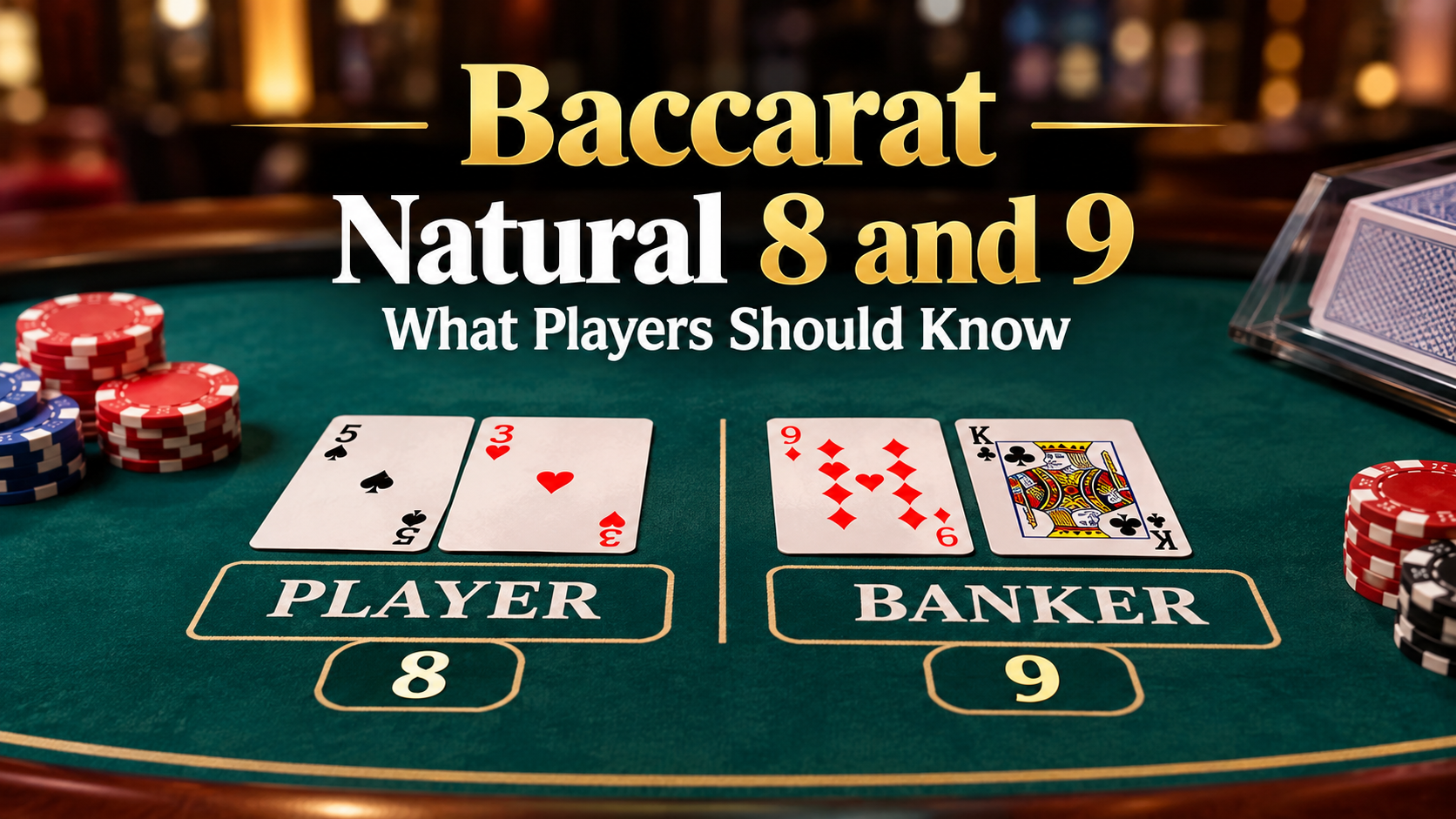
Baccarat Natural 8 and 9: What Players Should Know

September 15, 2026
In Baccarat, few moments are as straightforward—and exciting—as seeing an 8 or 9 appear in the first two cards. These hands are known as naturals, and understanding how they work can help players follow the action with far more confidence.
While Baccarat is often seen as a simple card game, its automatic drawing rules can confuse beginners. A natural 8 or natural 9 is one of the most important concepts to learn because it can end the round before any third cards are dealt. Whether you are new to the game or simply want a clearer understanding of table action, knowing the difference between these two powerful hands is essential.
What Is a Natural in Baccarat?
A natural occurs when the Player hand or Banker hand receives a total of 8 or 9 from its first two cards. Under standard Baccarat rules, the drawing sequence normally stops when a natural is present, meaning neither hand receives another card.
The basic principle is simple:
- Natural 9 is the highest possible hand.
- Natural 8 is the second-highest possible hand.
- If both sides have naturals, the higher total wins.
- If both sides have the same total, the result is a Tie.
For example, if the Player has a natural 9 and the Banker has 6, the Player wins immediately. If the Player has 8 and the Banker has 9, the Banker wins because 9 is higher.
Published game rules from regulators and casino operators confirm that an initial total of 8 or 9 is treated as a natural and stops further drawing under standard Baccarat procedures. This is also explained in the official-style Baccarat rules published by the Gambling Regulatory Authority of Singapore.
How Baccarat Card Values Work
Before understanding natural hands, players need to know how Baccarat totals are calculated.
Cards from 2 through 9 keep their face value. Aces count as 1, while 10s and face cards—Jack, Queen, and King—count as 0. Only the last digit of the total matters.
For example:
- 4 + 5 = 9
- Ace + 7 = 8
- 7 + 8 = 15, which counts as 5
- King + 6 = 6
- Queen + 9 = 9
This system means a total can never be higher than 9. When the first two cards produce an 8 or 9, the hand becomes a natural.
For players learning the game in more detail, guides available through Baccarat resources and gameplay information can help make the basic terminology and game flow easier to understand.
Natural 8: A Powerful Hand, but Not Always a Winner
A natural 8 is an excellent hand because only a natural 9 can beat it directly.
Imagine the following situation:
Player: 3 + 5 = 8
Banker: 4 + 2 = 6
The Player wins with a natural 8, and the round ends without additional cards.
However, an 8 is not unbeatable. Consider this example:
Player: Ace + 7 = 8
Banker: 4 + 5 = 9
Both hands are naturals, but the Banker wins because natural 9 is higher.
If both sides have an 8, the result is a Tie. The same principle applies when both hands have a natural 9. Standard Baccarat rules compare the final point totals, with equal totals producing a tie outcome.
Natural 9: The Best Possible Baccarat Hand
A natural 9 is the strongest hand available in Baccarat. Nothing can beat it.
For example:
Player: 4 + 5 = 9
Banker: King + 6 = 6
The Player wins immediately with a natural 9.
The only time a natural 9 does not produce a win is when the other side also has a natural 9. In that case, the result is a Tie.
One of the reasons natural 9 is easy to understand is that no complex third-card decision is needed. Once the initial cards reveal the natural, the round is resolved according to the comparison of the two totals.
Why No Third Card Is Drawn After a Natural
This is where many new players have questions. In standard Punto Banco Baccarat, players do not decide whether the Player or Banker hand should take another card. The drawing procedure follows fixed rules.
Normally, when there is no natural:
- Player draws on totals of 0 through 5.
- Player stands on 6 or 7.
- Banker follows a more detailed automatic drawing table.
However, naturals are checked before this normal sequence continues. If either initial hand has an 8 or 9, no further cards are normally dealt. The round ends and the hands are compared.
This is an important distinction for beginners: the Player and Banker labels do not mean you control the cards. In standard Baccarat, your primary decision is which outcome you want to bet on, while the dealing process itself follows predetermined rules.
Common Examples of Natural Hands
Here are a few quick scenarios that show how naturals work in real gameplay.
Example 1: Natural 8 Beats a Lower Hand
Player receives 6 + 2 = 8.
Banker receives 3 + 4 = 7.
The Player wins with a natural 8. No third card is dealt.
Example 2: Natural 9 Beats Natural 8
Player receives Ace + 7 = 8.
Banker receives 4 + 5 = 9.
Both sides have naturals, but 9 beats 8, so Banker wins.
Example 3: Matching Naturals
Player receives 3 + 6 = 9.
Banker receives 4 + 5 = 9.
Both sides have the same total, so the result is a Tie.
These examples highlight why it is useful to understand the first two cards before focusing on the more complicated third-card rules.
What Players Should Remember About Natural 8 and 9
The biggest lesson is that a natural is a game rule, not a special betting option. It simply describes a strong opening total of 8 or 9.
Keep these points in mind:
Natural 9 is the highest possible Baccarat total.
Natural 8 is the second-highest total.
Naturals are determined from the first two cards.
A natural normally ends the drawing sequence immediately.
Natural 9 beats natural 8.
Matching totals result in a Tie.
Understanding these basics can make Baccarat easier to follow, particularly for players who are watching a live table for the first time. The more complex Banker third-card rules only matter when neither side has a natural. A detailed breakdown of the standard automatic drawing sequence is also available in this Baccarat third-card rules guide, which outlines when additional cards may be dealt.
Frequently Asked Questions
What is a natural 8 in Baccarat?
A natural 8 occurs when either the Player or Banker hand totals exactly 8 with its first two cards. Under standard rules, no further cards are normally dealt once a natural is present.
Is a natural 9 better than a natural 8?
Yes. A natural 9 is the highest possible hand in Baccarat and beats a natural 8.
Can a third card be dealt after a natural?
Under standard Punto Banco rules, no. When either initial hand has a natural 8 or 9, the normal drawing sequence stops and the hands are compared.
What happens if both Player and Banker have a natural 8?
The round results in a Tie because both hands have the same final total.
What happens if both sides have a natural 9?
The result is also a Tie, as neither side has a higher total.
Do players choose whether to draw another card?
No. In standard Baccarat, the Player and Banker drawing rules are automatic. The bettor does not choose whether either hand hits or stands.
Final Thoughts
Natural 8 and 9 hands are among the easiest Baccarat rules to learn, yet they play an important role in understanding how every round begins. A natural 9 gives you the strongest possible total, while a natural 8 is just one point behind and can only lose directly to a 9. Most importantly, naturals stop the normal drawing process, allowing the round to be settled immediately.
For anyone exploring Baccarat more seriously, understanding naturals first creates a solid foundation before moving on to third-card rules, betting options, and other parts of the game. Remember that Baccarat outcomes are determined by chance and fixed game rules, so learning the mechanics can improve your understanding of the game without guaranteeing any particular result.