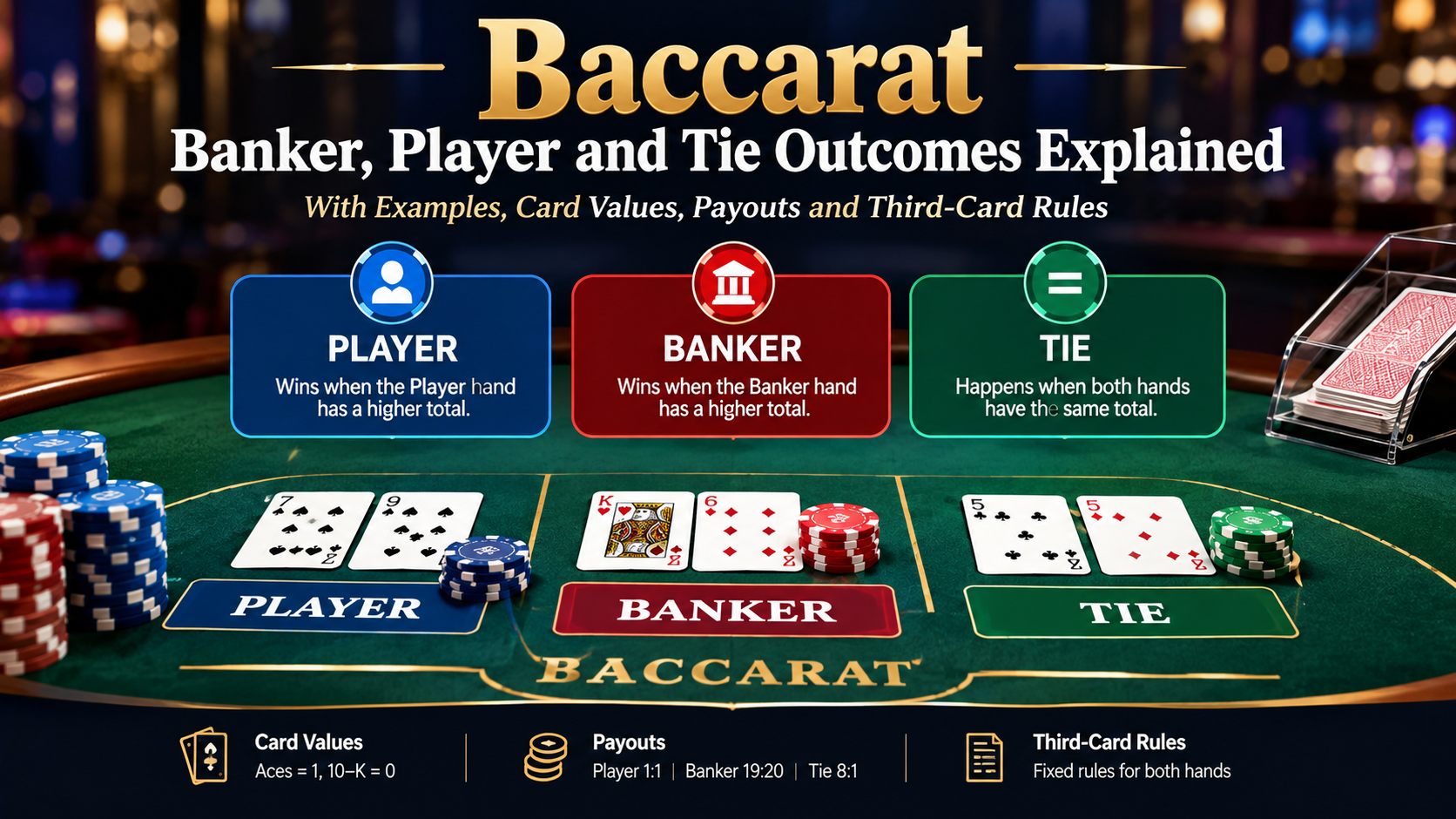
Baccarat Banker, Player and Tie Outcomes Explained With Examples

September 17, 2026
Baccarat is one of the most straightforward casino table games to understand once the basic betting options are clear. Unlike games where players make several decisions during a hand, baccarat follows fixed drawing rules, and the main choice is usually whether to bet on the Banker, Player, or Tie outcome.
Each hand compares two hands, known as the Banker and Player. The hand with the higher total wins, while an equal total produces a Tie. Understanding how these three outcomes work is important for anyone reading baccarat game information, comparing different tables, or simply trying to understand a baccarat result without confusion.
How Baccarat Scoring Works
Baccarat uses a simple card-value system. Aces are worth one point, cards from 2 through 9 retain their face value, while 10s, jacks, queens, and kings are worth zero.
The final score is based only on the last digit of the total. For example, if a hand contains a 7 and an 8, the combined value is 15, so the baccarat score is 5.
Consider another example:
- 6 + 2 = 8
- 9 + 7 = 16, giving a score of 6
- 4 + 8 = 12, giving a score of 2
The Banker and Player hands are then compared, and the higher score determines the winning outcome. Standard baccarat rules and card values are outlined in detail by Wizard of Odds.
What Does a Player Outcome Mean?
A Player outcome simply means that the Player hand finishes with a higher total than the Banker hand.
For example:
Player: 7
Banker: 5
In this situation, the Player wins because 7 is higher than 5.
The word “Player” can sometimes be confusing for newcomers because it does not necessarily refer to the person sitting at the table. It identifies one of the two baccarat hands. A person can bet on the Player outcome without personally controlling the cards in that hand.
Under standard baccarat rules, a winning Player bet normally pays even money.
What Does a Banker Outcome Mean?
A Banker outcome occurs when the Banker hand finishes with a higher score than the Player hand.
For example:
Player: 4
Banker: 8
The Banker wins because its final total is higher.
The Banker bet is slightly different from the Player bet because standard baccarat normally applies a 5% commission to winning Banker wagers. A typical winning Banker bet therefore pays 19 to 20 rather than a full even-money return.
The reason for this difference is connected to the mathematical advantage created by baccarat’s fixed drawing rules. In an eight-deck standard game, Wizard of Odds calculates a house edge of approximately 1.06% for the Banker bet compared with 1.24% for the Player bet.
These figures describe long-term mathematical expectations and do not predict the result of an individual hand.
What Happens When There Is a Tie?
A Tie occurs when both hands finish with exactly the same score.
For example:
Player: 6
Banker: 6
Neither the Player nor Banker hand wins because their totals are equal.
In standard baccarat, Player and Banker bets generally push when a Tie occurs, meaning the original wager is returned. The separate Tie wager wins when the two hands finish on the same total. A common standard payout for the Tie bet is 8 to 1, although rules and payouts can vary between games and operators.
The Tie outcome is less common than either a Banker or Player win. In an eight-deck standard baccarat analysis, Wizard of Odds gives the probability of a Tie as about 9.52%.
Simple Baccarat Outcome Examples
Looking at individual examples makes the three outcomes easier to understand.
Example 1: Player Wins
Suppose the cards produce these final scores:
Player: 8
Banker: 6
The Player hand has the higher score, so the result is a Player win.
Example 2: Banker Wins
Now consider:
Player: 3
Banker: 7
The Banker has the higher total, so the result is a Banker win.
Example 3: Tie
Finally:
Player: 5
Banker: 5
Both hands have the same score. The result is a Tie.
These examples show why understanding the final baccarat score is more important than simply adding the card values without applying the single-digit scoring rule.
Why Can a Third Card Be Dealt?
Baccarat does not allow players to freely decide whether to draw another card. Instead, third-card decisions follow predetermined rules.
The Player hand has specific rules determining when a third card is drawn. The Banker drawing procedure can then depend on both the Banker’s current score and, in certain situations, the third card received by the Player hand.
For example, when the Player draws a third card, the Banker’s decision can change according to that card’s value. This fixed structure is one reason baccarat does not require the same type of decision-making found in blackjack.
The detailed drawing rules can be useful when comparing baccarat variants because some versions modify standard rules or introduce alternative payouts.
Banker, Player and Tie Bets Are Not Mathematically Identical
Although Banker, Player, and Tie are the three familiar outcomes, they do not carry the same mathematical characteristics.
In an eight-deck standard baccarat game, Wizard of Odds lists approximate house edges of:
- Banker: 1.06%
- Player: 1.24%
- Tie: 14.36% when the Tie pays 8 to 1
The figures can change when the payout structure or rules are changed. For example, some baccarat variants use commission-free Banker bets but introduce different conditions for particular Banker wins.
This is why checking the exact rules and payout table is important instead of assuming every baccarat table operates identically.
How to Read Baccarat Results Correctly
New players sometimes look at previous results and assume that a sequence of Banker, Player, or Tie outcomes provides a reliable prediction for the next hand. However, previous results should not be treated as a guarantee of what comes next.
In standard baccarat, each hand is determined by the cards dealt according to the game’s rules. Historical sequences can describe what has already happened, but they do not establish a certain future result. Wizard of Odds also notes that, for practical purposes, past hand histories do not provide a reliable prediction method for the next hand.
For this reason, baccarat information is most useful when it explains the rules, payouts, probabilities, and differences between variants rather than presenting past results as a prediction tool.
What Should Players Check Before Playing Baccarat?
Before choosing a baccarat table, it can be useful to check several details:
- Betting limits: Check the minimum and maximum wager.
- Payouts: Confirm how Banker, Player, and Tie bets are paid.
- Commission: See whether the Banker bet carries the standard commission.
- Game rules: Check whether the table follows standard baccarat rules.
- Variant details: Some versions introduce special rules or side bets.
- Responsible gambling tools: Set a budget and avoid wagering more than you can afford to lose.
Reading these details first can make the difference between understanding a baccarat table and relying on assumptions.
FAQs About Baccarat Outcomes
Is Banker the same as the casino?
No. “Banker” identifies one of the two hands used to determine the baccarat result. It does not mean that the casino is controlling that hand.
What happens to a Player bet during a Tie?
Under standard baccarat rules, a Tie generally causes Player and Banker bets to push, meaning the original wager is returned. The exact treatment can depend on the table rules.
Does a Tie happen often in baccarat?
A Tie is less common than either a Banker or Player win. In an eight-deck standard baccarat analysis, the Tie probability is approximately 9.52%.
Why does the Banker bet usually have a commission?
The standard commission reflects the mathematical advantage associated with the Banker outcome. A common arrangement pays 95% profit on a winning Banker wager rather than a full even-money return.
Can previous baccarat results predict the next outcome?
Previous results do not provide a reliable guarantee of the next outcome. They can be recorded as historical results, but each new hand is determined by the cards dealt under the applicable rules.
Are all baccarat games played with the same rules?
No. Standard baccarat is widely used, but variants can modify payouts, commissions, or special features. Checking the individual game’s rules is therefore important before playing.
Final Thought
Baccarat becomes much easier to follow once the Banker, Player, and Tie outcomes are clearly understood. The scoring system is simple, while the drawing procedure follows predetermined rules rather than player decisions.
The most useful approach is to check the specific table’s rules, payouts, betting limits, and variant details before playing. Reliable baccarat game information can also help readers understand how different outcomes work without confusing short-term results with long-term mathematical probabilities.
Whether someone is new to baccarat or comparing different versions of the game, understanding the three primary outcomes provides a solid foundation for reading the table and interpreting each hand correctly.