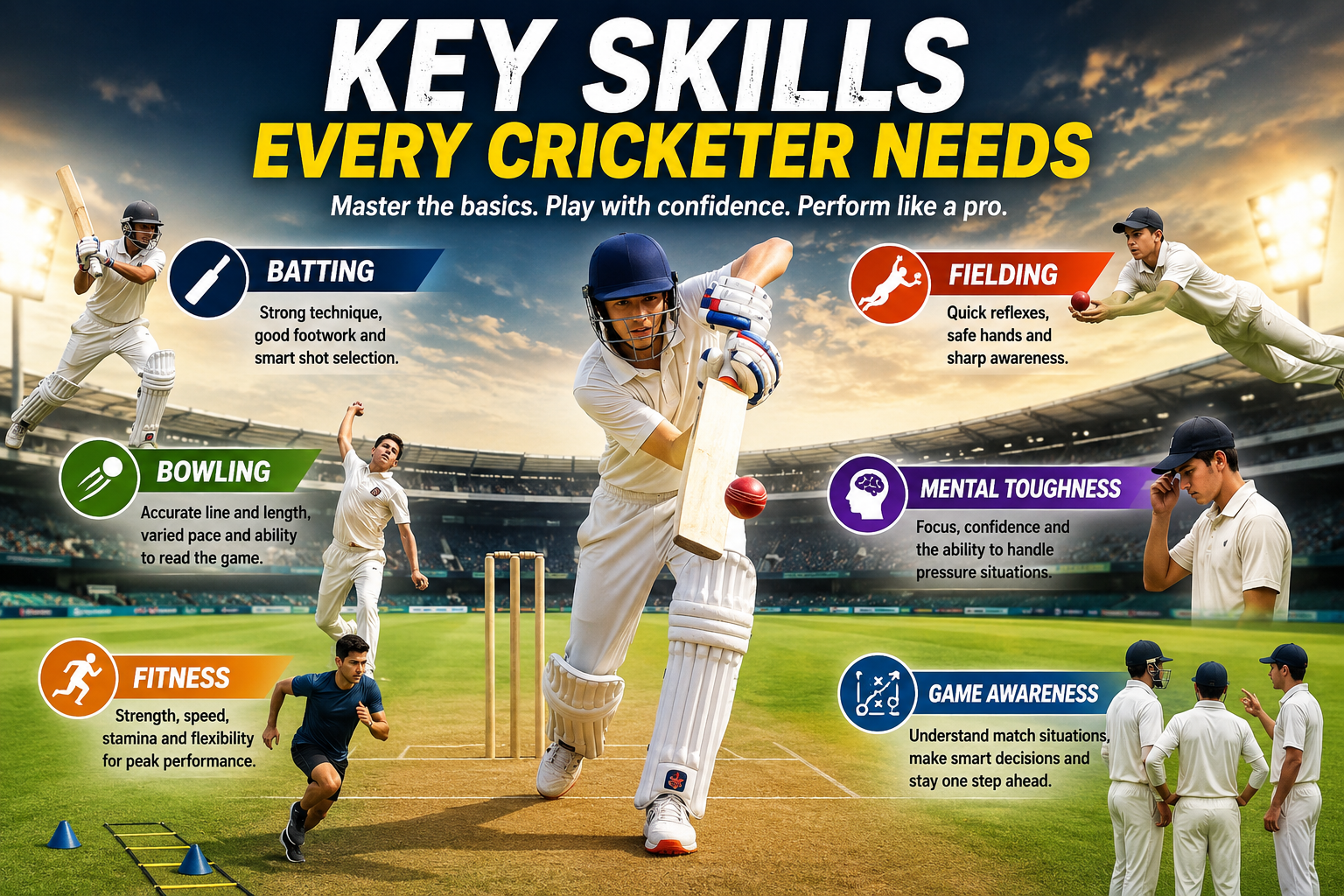
Key Skills Every Cricketer Needs to Master for Success

June 4, 2026
Key Skills Every Cricketer Needs to Master for Success
Cricket is more than just hitting boundaries or taking wickets. It is a game that combines technical ability, physical fitness, mental strength, and smart decision-making. Whether you are a beginner stepping onto the field for the first time or an experienced player aiming to improve your performance, mastering the right cricket skills can make a significant difference.
The best cricketers in the world are not successful because of a single talent. Instead, they develop a complete skill set that helps them perform consistently in different match situations. In this article, we will explore the key skills every cricketer needs to master to become a more effective and confident player.
1. Strong Batting Fundamentals
Batting is one of the most important aspects of cricket. A solid batting foundation allows players to score runs consistently and handle different types of bowlers.
Key batting skills include:
- Correct grip and stance
- Proper footwork
- Shot selection
- Timing and balance
- Ability to read the ball early
Good footwork helps a batter adjust to different deliveries, while proper shot selection reduces the risk of getting out unnecessarily. Players should focus on practicing both defensive and attacking shots to become versatile batsmen.
For professional batting techniques, players can learn from resources provided by the International Cricket Council (ICC): ICC Cricket.
2. Accurate and Effective Bowling
Bowling is not just about speed. Successful bowlers combine accuracy, consistency, and strategy to challenge batters.
Essential bowling skills include:
- Maintaining a consistent run-up
- Controlling line and length
- Developing bowling variations
- Proper follow-through
- Understanding match situations
Fast bowlers focus on pace, swing, and seam movement, while spin bowlers rely on turn, flight, and deception. Regardless of style, accuracy remains one of the most important bowling qualities.
Regular target practice helps bowlers improve their consistency and build confidence under pressure.
3. Exceptional Fielding Ability
Modern cricket places enormous importance on fielding. A single run-out, catch, or boundary save can completely change the outcome of a match.
Important fielding skills include:
- Safe catching techniques
- Quick reflexes
- Accurate throwing
- Ground fielding
- Agility and speed
Top teams invest heavily in fielding drills because fielding impacts every phase of the game. Players should practice catching from different angles and improve their reaction speed through specialized exercises.
4. Fitness and Physical Conditioning
Cricket may not appear as physically demanding as some sports, but high-level performance requires excellent fitness.
A cricketer’s fitness program should focus on:
- Strength training
- Endurance development
- Speed and agility
- Flexibility and mobility
- Injury prevention
Strong legs improve running between wickets, while core strength supports both batting and bowling performance. Fitness also helps players maintain concentration during long matches.
For cricket-specific fitness insights, players can explore guidance from the England and Wales Cricket Board (ECB).
5. Mental Toughness and Match Temperament
Cricket is often described as a mental game. Players frequently face pressure situations that test their concentration and confidence.
Mental skills every cricketer should develop include:
- Focus and concentration
- Confidence under pressure
- Positive self-talk
- Emotional control
- Resilience after mistakes
Even highly skilled players can struggle if they lose focus or become frustrated. Learning how to stay calm after a dropped catch or a poor shot is essential for long-term success.
Visualization techniques and pre-match routines can help players prepare mentally and improve performance.
6. Game Awareness and Tactical Thinking
Understanding the game is just as important as technical skill. Smart players constantly assess conditions and adapt their strategies accordingly.
Game awareness involves:
- Reading field placements
- Understanding match situations
- Rotating strike effectively
- Planning bowling strategies
- Making quick decisions
Experienced cricketers know when to attack and when to defend. This awareness often separates good players from great players.
Watching professional matches and analyzing player decisions can significantly improve cricket intelligence.
7. Hand-Eye Coordination
Hand-eye coordination plays a major role in batting, fielding, and wicketkeeping.
Benefits of strong hand-eye coordination include:
- Better shot execution
- Improved catching ability
- Faster reaction times
- Enhanced ball tracking
Players can improve coordination through catching drills, reaction exercises, and regular net practice.
The ability to quickly judge the ball’s speed, movement, and trajectory often determines success on the cricket field.
8. Communication and Teamwork
Cricket is a team sport, and communication is essential for smooth coordination.
Good communication helps with:
- Calling for catches
- Running between wickets
- Field placements
- Team strategy discussions
- Maintaining positive team morale
Strong teamwork creates a supportive environment where players can perform at their best.
Final Thoughts
Becoming a successful cricketer requires much more than natural talent. Players must continuously develop their batting, bowling, fielding, fitness, mental strength, and game awareness. Each skill contributes to overall performance and helps players handle the challenges of competitive cricket.
The most successful cricketers are lifelong learners who consistently work on improving every aspect of their game. By focusing on these essential skills and practicing them regularly, any player can build a strong foundation for long-term cricket success.
Frequently Asked Questions (FAQs)
What is the most important skill in cricket?
There is no single most important skill. Batting, bowling, fielding, fitness, and mental strength all contribute to overall performance.
How can young cricketers improve quickly?
Young players can improve by practicing regularly, working with qualified coaches, maintaining fitness, and participating in competitive matches.
Why is fitness important in cricket?
Fitness improves endurance, strength, agility, and injury prevention, helping players perform consistently throughout a match.
How do cricketers develop mental toughness?
Mental toughness is developed through experience, visualization, positive self-talk, goal setting, and learning to stay calm under pressure.
How often should a cricketer practice?
Most coaches recommend structured practice several times per week, combining technical training, fitness sessions, and match experience.