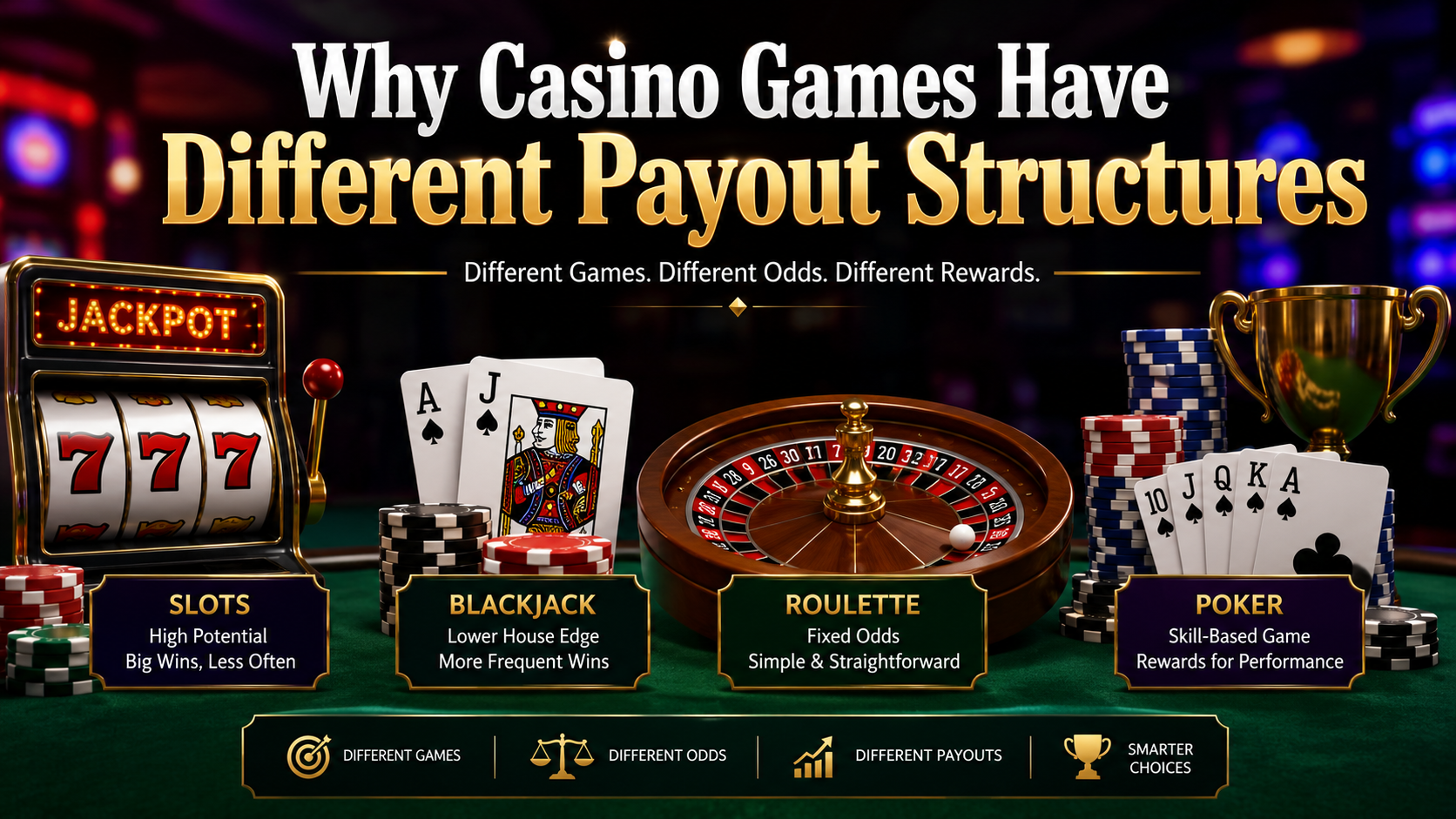
Why Different Casino Games Have Different Payout Structures

July 24, 2026
When people first explore online casinos, one question often comes to mind: Why do different casino games offer different payout structures? A slot machine might advertise a massive jackpot, while blackjack pays almost even money on most wins. Roulette has fixed odds, and poker tournaments follow a completely different reward system.
The answer lies in how each game is designed. Every casino game combines mathematics, probability, player skill, and entertainment in a unique way. Understanding these differences helps players make informed decisions instead of focusing only on the biggest advertised payouts.
Whether you are new to online gaming or already familiar with casino platforms, learning how payout structures work can improve your overall gaming experience and help you manage expectations.
What Is a Casino Payout Structure?
A payout structure is the system that determines how much a player receives after winning a particular bet. It is based on several factors, including:
- Probability of winning
- Game volatility
- House edge
- Bonus features
- Progressive jackpots
- Player skill (in some games)
Not every game follows the same mathematical model, which is why payouts vary across different casino categories.
The Relationship Between Risk and Reward
One of the biggest reasons payout structures differ is the balance between risk and reward.
Games that are easier to win usually offer smaller payouts because the chances of winning are higher. On the other hand, games with lower winning probabilities often provide much larger rewards.
For example:
- Blackjack offers frequent winning opportunities but relatively smaller payouts.
- Progressive slot games may pay life-changing jackpots, but those wins are extremely rare.
- Roulette provides fixed payouts based on the odds of each bet.
This balance allows casinos to offer a variety of experiences for different types of players.
House Edge Plays a Major Role
Every casino game includes a built-in mathematical advantage known as the house edge.
The house edge represents the average percentage that the casino expects to retain over time. It doesn’t guarantee short-term results but affects long-term outcomes.
Examples include:
- Blackjack (with optimal strategy): Very low house edge
- Baccarat: Low house edge on Banker bets
- European Roulette: Moderate house edge
- Most Slot Games: Varies depending on the title
Games with a lower house edge generally provide more consistent returns over time, while games with higher house edges often compensate by offering exciting bonus features or larger jackpots.
Slots Have Flexible Payout Models
Slot games are among the most diverse casino games because developers have complete freedom when designing payout systems.
A slot machine may include:
- Free spins
- Multipliers
- Bonus rounds
- Expanding wilds
- Progressive jackpots
- High-volatility rewards
Instead of paying frequently, some slots are designed to deliver fewer but much larger wins.
This flexibility explains why one slot may return small prizes regularly while another saves most of its value for rare jackpot combinations.
Table Games Follow Mathematical Odds
Unlike slots, table games rely on fixed mathematical probabilities.
Blackjack
Blackjack rewards decision-making. Players who understand basic strategy often experience better long-term results compared to random play.
Traditional blackjack typically pays 3:2 for a natural blackjack, although some tables now offer 6:5, which significantly changes the expected return.
Roulette
Roulette payouts directly reflect the odds.
Examples include:
- Straight number: 35:1
- Split bet: 17:1
- Red/Black: 1:1
The simplicity of roulette makes its payout system easy to understand.
Baccarat
Baccarat uses straightforward payouts:
- Banker Bet: Usually 1:1 (minus commission)
- Player Bet: 1:1
- Tie Bet: Higher payout but much lower winning probability
Skill-Based Games Offer Different Rewards
Games involving player decisions naturally use different payout structures.
Poker is one of the best examples.
Unlike slots or roulette, poker players compete against each other instead of the casino. Tournament prize pools depend on:
- Number of entrants
- Buy-in amount
- Tournament format
- Final rankings
The better a player performs, the larger the reward.
This creates a completely different payout model compared to traditional casino games.
Volatility Changes the Player Experience
Another important factor is volatility, sometimes called variance.
Low Volatility
Players receive:
- Smaller wins
- More frequent payouts
- Longer playing sessions
Medium Volatility
Players experience:
- Balanced rewards
- Moderate risk
- Consistent gameplay
High Volatility
Players may encounter:
- Longer losing streaks
- Bigger individual wins
- Larger jackpot opportunities
Volatility doesn’t change the total expected return but significantly affects how players experience the game.
Progressive Jackpots Need Different Payout Structures
Progressive jackpot games are unique because a small percentage of every wager contributes to a growing jackpot.
This means:
- Regular payouts may be smaller.
- The jackpot increases continuously.
- Rare winners receive extremely large prizes.
Millions of players contribute to these jackpots, allowing them to reach impressive amounts before someone wins.
Why Casinos Don’t Use the Same Payout for Every Game
If every casino game paid identical rewards, gaming would quickly become repetitive.
Different payout structures help casinos provide:
- More entertainment options
- Different risk levels
- Various playing styles
- Better game diversity
- Unique player experiences
Some players enjoy consistent wins, while others chase large jackpots. Offering multiple payout models keeps games appealing to a broader audience.
Understanding RTP alongside Payout Structures
Many players confuse payout structures with Return to Player (RTP).
They are related but not identical.
- RTP represents the theoretical percentage returned to players over millions of game rounds.
- Payout structure determines how those returns are distributed.
For example:
Two slot games may both have 96% RTP, but one pays frequent small prizes while the other reserves most of its return for occasional large wins.
Learning the difference helps players choose games that match their preferred playing style.
For a deeper understanding of RTP, game fairness, and responsible online gaming, resources from the UK Gambling Commission provide reliable information.
Choosing Games Based on Payout Structure
Rather than chasing the biggest advertised jackpot, players should consider:
- Their preferred level of risk
- Available bankroll
- Session length
- House edge
- RTP
- Game volatility
- Personal entertainment goals
Players who enjoy steady gameplay may prefer blackjack or baccarat, while those looking for excitement often gravitate toward high-volatility slots.
If you’re exploring different casino categories and comparing games, platforms like CricBet99 offer information on popular casino options, sports betting markets, and live gaming experiences. You can learn more by visiting Cricbet99 and exploring the games that best suit your playing preferences.
FAQs
Why do slot machines have bigger jackpots than blackjack?
Slots generally have much lower odds of hitting the highest prize, allowing developers to offer significantly larger jackpots while maintaining the game’s mathematical balance.
Does a higher payout mean a game is better?
Not necessarily. A larger payout often comes with lower winning odds. The best game depends on your goals, budget, and preferred level of risk.
What is the difference between RTP and payout structure?
RTP measures the theoretical percentage returned to players over time, while the payout structure explains how those returns are distributed across wins.
Which casino games usually have the lowest house edge?
Blackjack, baccarat (Banker bet), and certain video poker variants are generally known for having relatively low house edges when played correctly.
Should beginners focus on payout structures?
Yes. Understanding payout structures helps beginners choose games that match their expectations and encourages more informed, responsible gameplay.
Final Thought
Different casino games have different payout structures because each one is built around its own combination of probability, risk, player involvement, and entertainment value. A jackpot slot, a blackjack table, and a roulette wheel are designed to deliver completely different experiences, so it makes sense that their rewards are calculated differently.
Instead of focusing solely on the size of a potential win, players benefit more from understanding how payouts, RTP, house edge, and volatility work together. This knowledge leads to smarter game selection, realistic expectations, and a more enjoyable overall experience. Whether you prefer consistent action or the thrill of chasing a big jackpot, choosing games that align with your playing style is always the better strategy.