Understanding Casino Return-to-Player (RTP) vs Hit Frequency: What Every Player Should Know

July 15, 2026
Understanding Casino Return-to-Player (RTP) vs Hit Frequency: What Every Player Should Know
If you’ve spent any time exploring online casino games, you’ve likely come across the terms Return-to-Player (RTP) and Hit Frequency. While these two metrics are often mentioned together, they represent different aspects of how a casino game performs. Understanding the difference can help you make more informed decisions and set realistic expectations before you start playing.
Many players mistakenly believe that a higher RTP automatically means they’ll win more often. In reality, a game with a high RTP can still have long losing streaks, while another game with a lower RTP may deliver frequent but smaller payouts. That’s why it’s important to understand both RTP and hit frequency instead of focusing on just one statistic.
In this guide, we’ll explain what these terms mean, how they work together, and why they matter when choosing an online casino game.
What Is Return-to-Player (RTP)?
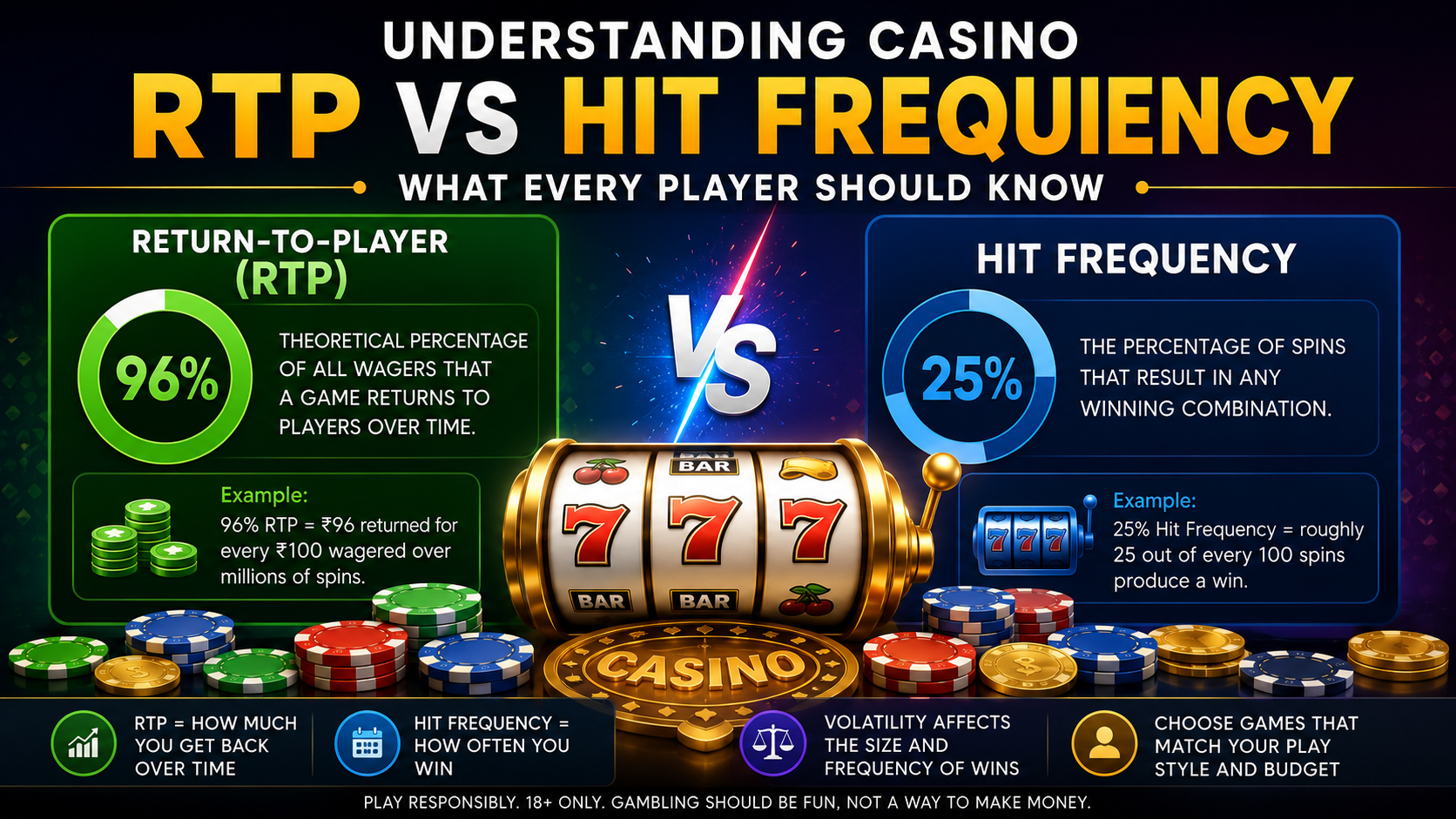
Return-to-Player, commonly known as RTP, is the theoretical percentage of all wagered money that a casino game is expected to return to players over a very large number of spins or rounds.
For example, if a slot game has an RTP of 96%, it theoretically returns ₹96 for every ₹100 wagered over millions of spins. The remaining ₹4 represents the casino’s mathematical advantage, also known as the house edge.
It’s important to remember that RTP is calculated over the long term. It doesn’t predict what will happen during a single gaming session. A player could experience a significant win within a few spins or go through an extended losing streak despite playing a high-RTP game.
What Is Hit Frequency?
Hit Frequency measures how often a slot machine produces a winning combination.
For example:
- 20% Hit Frequency means approximately 20 out of every 100 spins will result in a winning combination.
- 35% Hit Frequency means around 35 out of every 100 spins will produce some type of payout.
However, hit frequency doesn’t indicate the size of those wins. Many winning spins may return less than the original wager, while others could provide larger rewards.
In simple terms, hit frequency tells you how often you win, not how much you win.
RTP vs Hit Frequency: Understanding the Difference
Although both metrics are expressed as percentages, they serve different purposes.
| Return-to-Player (RTP) | Hit Frequency |
| Measures long-term payout percentage | Measures how often wins occur |
| Reflects theoretical returns | Reflects winning frequency |
| Doesn’t show how often you’ll win | Doesn’t show the size of wins |
| Calculated over millions of game rounds | Based on the occurrence of winning combinations |
Think of it this way:
- RTP focuses on value returned over time.
- Hit Frequency focuses on the number of winning spins.
Understanding both gives you a more complete picture of how a game behaves.
Why a High RTP Doesn’t Guarantee Frequent Wins
One of the biggest misconceptions among casino players is that a higher RTP guarantees more frequent payouts.
Consider these two examples:
Game A
- RTP: 97%
- Hit Frequency: 18%
This game may produce fewer winning spins, but some payouts could be relatively large.
Game B
- RTP: 94%
- Hit Frequency: 40%
This game pays out much more frequently, but many of those wins might be small and only partially cover your wager.
This demonstrates why RTP and hit frequency should always be considered together rather than independently.
The Importance of Volatility
Another factor that influences gameplay is volatility, also known as variance.
Volatility describes the balance between the size and frequency of payouts.
Low Volatility
- Frequent small wins
- Lower risk
- Longer playing sessions
- Suitable for casual players
Medium Volatility
- Balanced payouts
- Mix of small and medium wins
- Consistent gameplay experience
High Volatility
- Less frequent wins
- Higher risk
- Potential for larger payouts
- Suitable for players comfortable with longer losing streaks
Volatility works alongside RTP and hit frequency to create the overall playing experience.
How RTP, Hit Frequency, and Volatility Work Together
No single statistic tells the whole story.
A slot game could offer:
- High RTP
- Low Hit Frequency
- High Volatility
Another could feature:
- Slightly lower RTP
- Higher Hit Frequency
- Low Volatility
Neither option is inherently better. Some players enjoy frequent small wins that keep gameplay engaging, while others prefer games that offer the possibility of larger rewards, even if those wins come less often.
Choosing a game that matches your preferences is more important than chasing a single number.
Tips for Choosing the Right Casino Games
When comparing online slots, keep these points in mind:
1. Check the RTP
Many experienced players look for games with an RTP of 96% or higher, although RTP should never be the only deciding factor.
2. Consider Hit Frequency
If you prefer seeing regular winning combinations, games with a higher hit frequency may provide a more enjoyable experience.
3. Understand Volatility
Your bankroll and risk tolerance should influence the type of volatility you choose.
4. Play on Licensed Platforms
Always choose reputable casinos that publish RTP information and use independently tested games.
If you’re interested in learning more about casino games, betting strategies, and responsible gaming concepts, explore the online casino guides and betting resources available on CricBet99. The platform offers educational content designed to help players better understand casino mechanics before they begin playing.
Why Licensed Casinos Publish RTP
Licensed game developers and reputable online casinos openly publish RTP values because transparency helps players understand how games are designed.
Independent testing organizations regularly verify game fairness and payout percentages. One of the most recognized testing authorities is eCOGRA, which audits casino software and promotes fair gaming standards.
Common Myths About RTP and Hit Frequency
Myth 1: High RTP Means You’ll Win Today
False. RTP reflects long-term mathematical performance, not short-term results.
Myth 2: High Hit Frequency Means Bigger Wins
Incorrect. It only indicates how often winning combinations occur, not their value.
Myth 3: Low RTP Games Never Pay Well
Not necessarily. Any individual gaming session can produce significant payouts because outcomes are random.
Myth 4: RTP Eliminates Risk
No casino game is risk-free. RTP simply provides a statistical expectation over an extended period.
FAQs
What is a good RTP for online slot games?
An RTP of 96% or higher is generally considered competitive, although volatility and hit frequency should also be considered.
Is hit frequency more important than RTP?
Neither is more important. RTP measures long-term returns, while hit frequency measures how often winning combinations occur.
Can two games have the same RTP but feel completely different?
Yes. Differences in hit frequency and volatility can create very different gameplay experiences even when RTP values are identical.
Does RTP guarantee profits?
No. RTP is a theoretical average calculated over millions of game rounds and cannot predict individual outcomes.
Where can players find a game’s RTP?
Most licensed casinos and software providers display RTP information within the game’s help or information section.
Final Thought
Understanding Return-to-Player (RTP) and Hit Frequency is essential for anyone who wants to make informed decisions when exploring online casino games. While RTP provides insight into a game’s long-term payout potential, hit frequency explains how often winning combinations are likely to appear. Adding volatility into the equation gives you a more complete understanding of how a game behaves.
Instead of focusing on a single statistic, evaluate RTP, hit frequency, and volatility together. This balanced approach will help you choose games that align with your preferences, manage expectations realistically, and enjoy a more informed gaming experience. Remember that casino games are based on chance, so the goal should always be entertainment and responsible play rather than guaranteed outcomes.