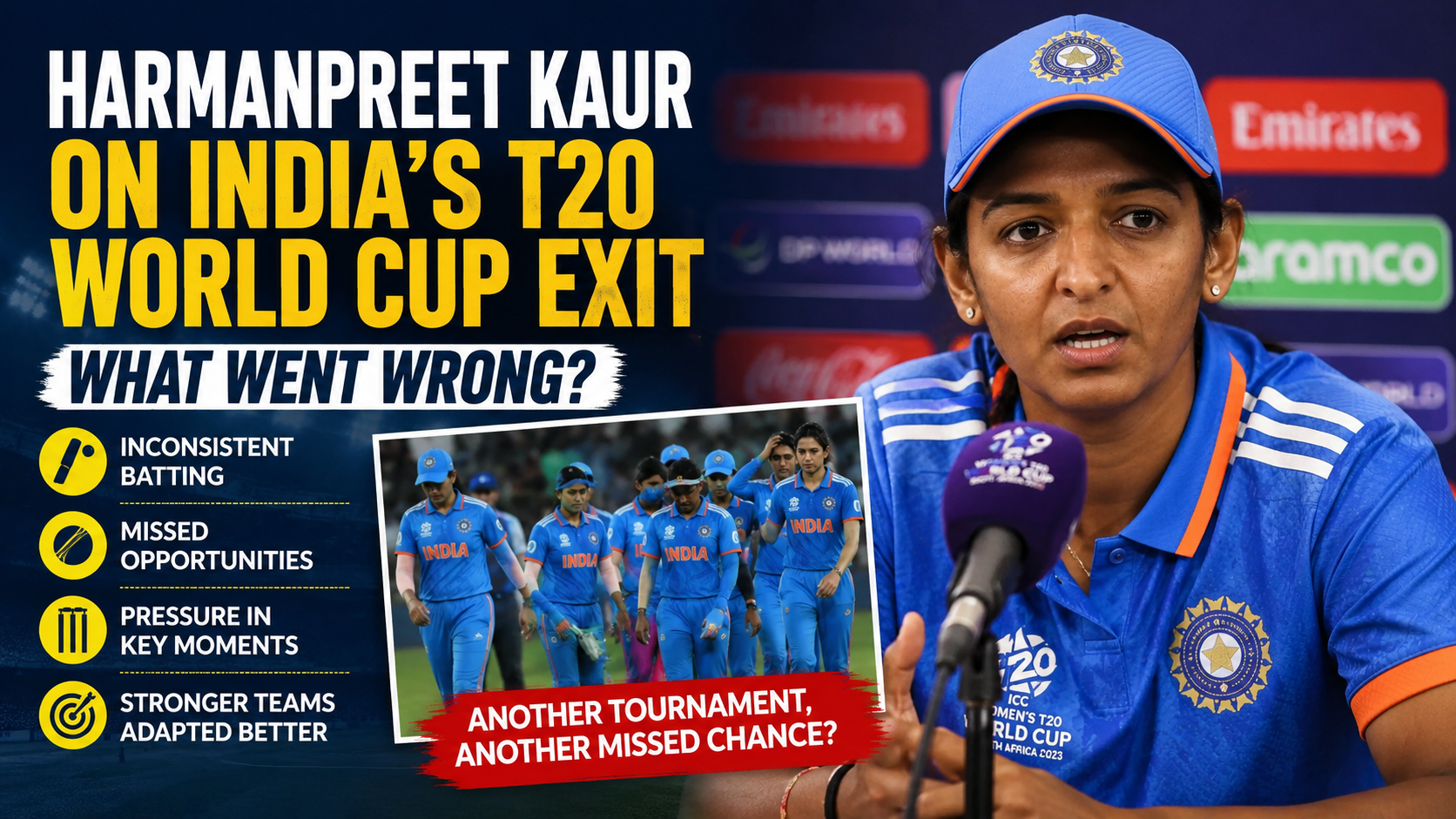
Harmanpreet Kaur Reacts to India’s T20 World Cup Exit: What Went Wrong?

June 29, 2026
Harmanpreet Kaur Reacts to India’s T20 World Cup Exit: What Went Wrong?
India’s dream of lifting the ICC Women’s T20 World Cup came to a disappointing end after a defeat to Australia, leaving fans frustrated and the team searching for answers. Captain Harmanpreet Kaur did not shy away from addressing the team’s shortcomings after the match, admitting that India once again failed to seize crucial moments against one of the strongest teams in world cricket.
The defeat highlighted several recurring issues, including inconsistent batting, missed opportunities in the field, and the inability to maintain pressure during key phases of the game. While India displayed flashes of brilliance throughout the tournament, their campaign ultimately ended because they could not produce a complete performance when it mattered the most.
Harmanpreet Kaur’s Honest Assessment
Following India’s elimination, Harmanpreet Kaur spoke openly about the team’s performance instead of making excuses. She emphasized that the players were aware of the expectations and accepted responsibility for not delivering in a high-pressure contest.
According to the Indian captain, the team had prepared well and believed they had the ability to compete with Australia. However, she admitted that failing to convert promising situations into match-winning moments proved costly once again.
Her post-match comments reflected disappointment but also determination, suggesting that the team would learn from the setback and continue building towards future ICC events.
The Match That Changed Everything
India entered the contest knowing that victory would keep their World Cup hopes alive. Unfortunately, Australia once again demonstrated why they remain one of the most dominant sides in women’s cricket.
India’s bowlers produced disciplined spells early in the innings, but Australia’s experienced middle order recovered well and posted a competitive total. Chasing under pressure, India’s batting lineup struggled to build lasting partnerships.
Several batters got promising starts but failed to convert them into match-winning innings. Against elite teams like Australia, losing wickets at regular intervals makes chasing difficult, and that pattern repeated itself.
The result ultimately ended India’s campaign before the knockout stage, leaving another opportunity unfulfilled.
What Went Wrong for India?
Inconsistent Top-Order Batting
One of India’s biggest challenges throughout the tournament was the lack of consistent starts from the top order. While individual players contributed in different matches, the batting unit rarely fired together.
Early wickets increased pressure on the middle order, forcing experienced players to rebuild instead of playing naturally.
Failure to Capitalize on Momentum
India created several opportunities during the match. Tight bowling spells, fielding pressure, and moments where Australia looked vulnerable could have shifted momentum.
However, dropped chances, loose deliveries, and periods of defensive cricket allowed Australia to regain control.
Winning ICC tournaments often depends on maximizing these small moments, and India struggled to do that consistently.
Middle-Order Pressure
The middle order carried enormous responsibility throughout the tournament. Whenever early wickets fell, the experienced batters had to rescue the innings while maintaining the required scoring rate.
Against Australia’s disciplined bowling attack, this proved extremely difficult.
Australia’s Championship Experience
Australia’s ability to remain calm under pressure once again made the difference. Their players adapted quickly to changing match situations, rotated strike effectively, and finished strongly with both bat and ball.
This experience continues to separate Australia from many other international teams during ICC tournaments.
A Familiar Story in ICC Knockout Races
India’s women’s team has made significant progress over the past decade, consistently reaching the latter stages of major tournaments. However, converting strong campaigns into championship victories remains a challenge.
The team possesses talented batters, quality spinners, and emerging fast bowlers, yet crucial matches often expose small weaknesses that stronger teams successfully exploit.
Harmanpreet Kaur acknowledged that improving consistency under pressure remains one of India’s biggest priorities moving forward.
Positives India Can Build On
Despite the disappointing exit, India’s campaign was not without encouraging signs.
Young players gained valuable experience competing against world-class opponents. The bowling attack showed discipline throughout much of the tournament, while several batters demonstrated the ability to play impactful innings.
These experiences can become valuable lessons ahead of future ICC competitions.
Developing stronger finishing abilities, improving fielding standards, and building more dependable batting partnerships could help India bridge the gap between being title contenders and becoming champions.
Lessons for the Future
The road ahead should focus on improving execution rather than making sweeping changes. India has already assembled a talented squad capable of competing with the world’s best teams.
Key areas for improvement include:
- Building consistent opening partnerships.
- Converting starts into match-winning scores.
- Improving fielding in pressure situations.
- Handling high-pressure moments with greater composure.
- Continuing to develop young players alongside experienced leaders.
If these areas improve, India will remain one of the strongest contenders in upcoming ICC tournaments.
FAQs
Why was India eliminated from the Women’s T20 World Cup?
India failed to defeat Australia in a crucial group-stage match, ending their chances of reaching the knockout stage.
What did Harmanpreet Kaur say after the defeat?
Harmanpreet Kaur admitted that India failed to capitalize on important moments and accepted responsibility for the team’s performance, emphasizing the need to learn from the experience.
What were India’s biggest weaknesses during the tournament?
The team’s main challenges included inconsistent batting, missed opportunities in the field, and an inability to maintain momentum during crucial phases of important matches.
Can India become stronger before the next ICC tournament?
Yes. India has a talented squad with experienced leaders and promising young players. Better consistency, improved finishing, and sharper fielding could significantly strengthen their chances.
Final Thoughts
India’s Women’s T20 World Cup journey ended with disappointment, but it also offered valuable lessons for the future. Harmanpreet Kaur’s honest reaction reflected a team willing to accept responsibility rather than look for excuses.
While the loss against Australia exposed familiar weaknesses, it also highlighted the potential within this Indian squad. Learning to perform consistently under pressure, converting opportunities into victories, and maintaining composure during defining moments will be essential if India hopes to lift an ICC trophy in the near future.