England vs New Zealand Test Series 2026: Match Analysis & Key Turning Points

June 10, 2026
England vs New Zealand Test Series 2026
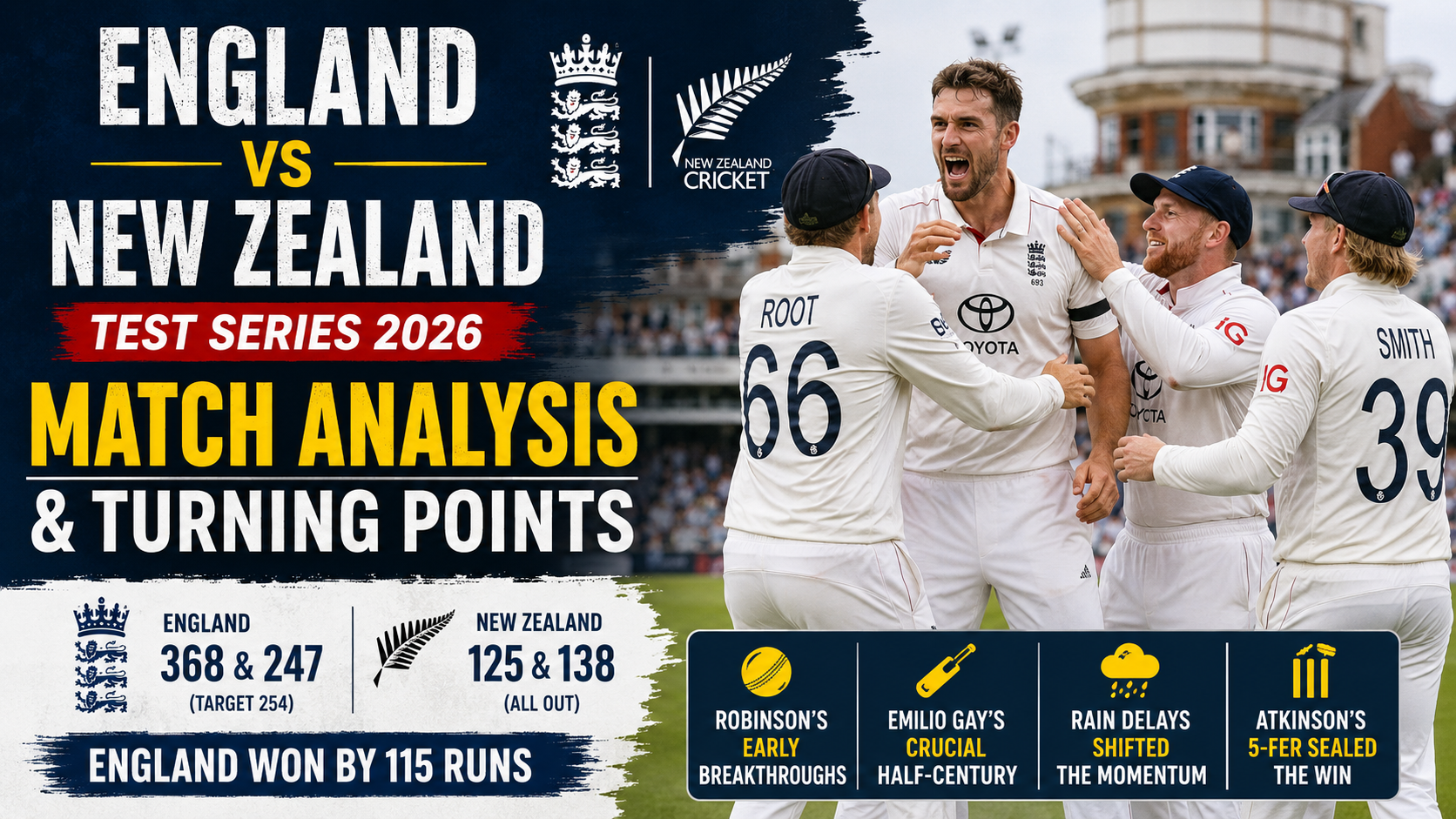
The England vs New Zealand Test Series 2026 got off to a dramatic start at Lord’s, with England securing a convincing 115-run victory in a rain-affected first Test. While the scoreline suggests a comfortable win, the match was filled with momentum swings, challenging batting conditions, and several defining moments that shaped the final outcome. England’s bowlers dominated throughout the contest, helping the hosts take a 1-0 lead in the three-match series.
Match Overview
The opening Test at Lord’s was expected to provide a balanced contest between bat and ball. Instead, the surface offered excessive seam movement and uneven bounce, making life extremely difficult for batters from both teams. The match ended inside four days, with England dismissing New Zealand for 138 in their second innings while defending a target of 254 runs. England ultimately claimed a 115-run victory and gained an early advantage in the series.
England’s Bowling Unit Sets the Tone
One of the biggest reasons behind England’s success was the outstanding performance of their pace attack. Ollie Robinson made a remarkable return to Test cricket and immediately made an impact. His ability to exploit the conditions consistently put New Zealand under pressure.
Robinson’s early breakthroughs in the first innings prevented New Zealand from building partnerships. His disciplined line and length exposed the visitors’ batting vulnerabilities and laid the foundation for England’s dominance.
Gus Atkinson then took over in the fourth innings, producing a match-winning five-wicket haul. His pace and accuracy ensured that New Zealand never got close to the target.
Turning Point 1: New Zealand’s First-Innings Collapse
The first major turning point came when New Zealand struggled badly in their first innings. England’s bowlers extracted significant movement from the pitch, and the visitors failed to adjust quickly.
Instead of building a competitive total, New Zealand lost wickets at regular intervals. This allowed England to gain control despite difficult batting conditions themselves. Once the Kiwis were unable to post a substantial score, England entered the remainder of the match with a psychological advantage.
Turning Point 2: Emilio Gay’s Crucial Half-Century
Batting was extremely difficult throughout the Test, which made every significant innings even more valuable. England debutant Emilio Gay played one of the most important knocks of the match by scoring a fighting half-century.
His innings helped England extend their lead and set New Zealand a challenging target. On a surface where even experienced batters struggled for consistency, Gay’s composure proved invaluable. England captain Ben Stokes later praised the youngster’s contribution, recognizing how important those runs were in the overall context of the game.
Turning Point 3: Rain Delays and Pressure Build-Up
Rain interruptions on Day 3 created uncertainty and temporarily delayed England’s push for victory. However, the stoppages arguably increased pressure on New Zealand.
When play resumed, New Zealand still required a significant number of runs while having already lost key wickets. England’s bowlers returned refreshed and immediately resumed their attack. The visitors never managed to recover from their vulnerable overnight position.
Turning Point 4: Atkinson’s Match-Sealing Spell
The final and most decisive turning point came on Day 4. New Zealand resumed at 55 for 5, still needing 199 runs for victory.
Devon Conway attempted to provide resistance, but wickets continued to fall around him. Gus Atkinson delivered a brilliant spell that dismantled the lower order and removed any remaining hopes of a New Zealand comeback. His five-wicket haul sealed England’s victory before lunch on the fourth day.
The Lord’s Pitch Controversy
While England deserved full credit for their performance, much of the post-match discussion centered around the Lord’s pitch. The surface offered excessive assistance to fast bowlers and produced uneven bounce throughout the match.
The International Cricket Council later rated the pitch as “unsatisfactory,” while the Marylebone Cricket Club (MCC) issued an apology regarding the playing conditions. Many cricket experts felt the surface reduced the balance between bat and ball, resulting in a contest heavily tilted in favor of bowlers.
What New Zealand Must Improve
New Zealand still has enough quality to bounce back in the series, but several areas need improvement:
- Top-order batters must show greater patience against the moving ball.
- Partnerships need to be prioritized over aggressive stroke play.
- Bowlers require more support from fielders through improved catching.
- Senior players must take responsibility in pressure situations.
If New Zealand can address these issues, the upcoming Tests could become far more competitive.
Final Thoughts
England’s 115-run victory at Lord’s was built on disciplined fast bowling, smart game management, and timely contributions from key players. Ollie Robinson’s return, Emilio Gay’s vital half-century, and Gus Atkinson’s match-winning spell were the defining factors behind the win. While the controversial pitch influenced the contest, England adapted far better than New Zealand and fully deserved their success.
With England leading 1-0, the remainder of the series promises to be fascinating. New Zealand will be eager to respond strongly, while England will look to maintain momentum and secure another memorable Test series victory on home soil.
FAQs
Who won the first Test between England and New Zealand in 2026?
England won the first Test by 115 runs at Lord’s.
Who was the standout performer for England?
Gus Atkinson was the standout performer with a match-winning five-wicket haul in New Zealand’s second innings.
Why was the Lord’s pitch criticized?
The pitch provided excessive seam movement and uneven bounce, leading the ICC to rate it as unsatisfactory.
What target did New Zealand chase in the fourth innings?
New Zealand were chasing 254 runs but were bowled out for 138.
What is the current series score?
England lead the three-match Test series 1-0.