Banker, Player and Tie Bets Compared: Which Baccarat Bet Makes More Sense?

September 2, 2026
Baccarat is one of the simplest casino games to understand, but choosing between the Banker, Player and Tie bets can make a noticeable difference to the overall betting experience. Unlike some casino games that require complicated strategies, baccarat gives players only a few primary betting options. The challenge is understanding what each wager means, how it pays, and how much of a mathematical advantage the house has.
For anyone new to baccarat, comparing these three bets before playing is more useful than simply choosing the option with the biggest potential payout. The Banker bet generally has the lowest house edge, while the Tie bet offers a much larger payout but comes with considerably higher risk.
What Are Banker, Player and Tie Bets?
The three main baccarat wagers are based on the outcome of the hand.
A Banker bet means you are predicting that the Banker hand will finish closer to nine than the Player hand. A Player bet predicts that the Player hand will have the higher final total. A Tie bet predicts that both hands will finish with the same total.
The names can sometimes be confusing for beginners. “Player” does not mean you are personally playing against the Banker. They are simply the names given to the two baccarat hands.
Once the cards are dealt according to baccarat’s fixed drawing rules, the hand with the higher total wins. Only the last digit of the combined card value counts, so a total of 15 becomes 5, for example.
Banker Bet: The Mathematical Favourite
Among the three standard wagers, the Banker bet is generally considered the strongest from a mathematical perspective.
In a conventional baccarat game, a winning Banker wager commonly pays even money minus a 5% commission. That commission exists because the Banker hand has a slightly higher probability of winning.
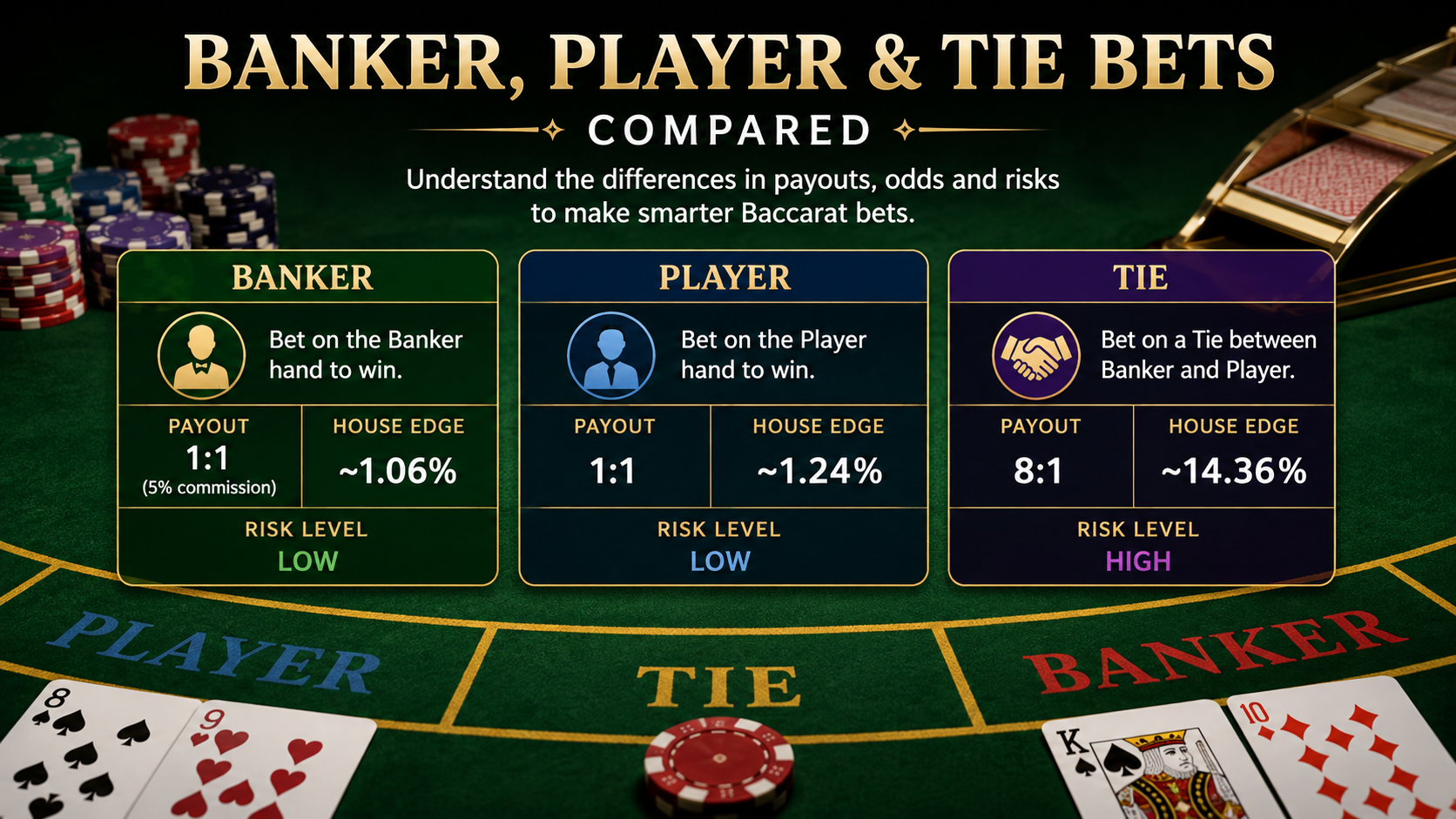
For an eight-deck game, the Banker bet has a house edge of approximately 1.06%.
That does not mean a Banker bet is guaranteed to win. Baccarat remains a game of chance, and individual hands can go either way. The lower house edge simply means that, over a very large number of statistically similar wagers, the expected loss is lower than with the Player or Tie bet.
For players comparing the three main options, this is the primary reason Banker is often the first bet they consider.
Player Bet: Simple and Straightforward
The Player bet is arguably the easiest wager to understand. You are betting that the Player hand will beat the Banker hand.
Winning Player bets normally pay 1:1, with no commission deducted. However, the mathematical advantage for the casino is slightly higher than on the Banker wager.
For an eight-deck baccarat game, the house edge on the Player bet is approximately 1.24%.
The difference between 1.06% and 1.24% may look small. For an occasional player, it may not feel significant during a short session. However, expected value becomes more relevant as the number of wagers increases.
The Player bet can therefore be a reasonable choice for someone who prefers its straightforward payout and does not want to deal with the standard Banker commission.
Tie Bet: Attractive Payout, Higher Risk
The Tie bet is where the comparison changes dramatically.
A Tie wager predicts that the Player and Banker hands will finish with the same total. Depending on the baccarat table, the payout can vary, but an 8:1 payout is common in standard games.
The large payout can make the Tie option look attractive, especially when compared with the even-money returns available from Banker and Player wagers. However, the probability of a tie is much lower than the probability of either side winning.
On an eight-deck game, the Tie bet has a house edge of approximately 14.36% when it pays 8:1.
That is substantially higher than the house edge on either Banker or Player. The lesson is simple: a bigger advertised payout does not automatically make a bet better from a mathematical standpoint.
Banker vs Player vs Tie
| Bet | Typical Payout | Approx. House Edge* | Risk Profile |
| Banker | 1:1 minus 5% commission | 1.06% | Lower |
| Player | 1:1 | 1.24% | Lower |
| Tie | Often 8:1 | 14.36% | Much higher |
*Figures shown are based on an eight-deck conventional baccarat analysis. Actual rules and payouts can vary between tables.
This comparison makes the difference easier to see. Banker and Player are relatively close in mathematical terms, whereas the Tie wager sits in a completely different risk category.
Does a Winning Streak Change the Next Bet?
One of the biggest misconceptions surrounding baccarat is the belief that previous results can predict the next hand.
For example, a player may see several consecutive Banker results and assume that Player is now “due.” Another player might follow a long Player streak because they believe momentum will continue.
Neither approach changes the underlying probability of the next hand.
Previous results can create interesting patterns on a baccarat scoreboard, but they do not guarantee what happens next. A sequence such as Banker-Banker-Player-Tie does not mathematically force the next result to be any particular outcome.
This is why understanding the wager itself is more valuable than trying to predict patterns.
How Should Beginners Compare the Three Bets?
A sensible comparison starts with three questions: What does the bet pay? What is the house edge? And how much volatility am I comfortable with?
Banker is generally preferred by players focused on the lowest house edge among the standard bets. Player provides a similar type of wager with an uncomplicated 1:1 payout. Tie offers the possibility of a larger return but carries a much higher house advantage.
Players researching online casino options may also come across baccarat guides and account-related information while comparing platforms. For those checking cricket and casino-related services, the Cricbet99 ID Provider section can be considered alongside the platform’s available information and support resources. Always verify the applicable rules, eligibility requirements and local regulations before using any betting or gaming service.
The key point is not to treat any of these bets as a guaranteed way to make money. House edge describes long-term mathematical expectation, not the result of an individual hand.
Why Table Rules Matter
Not every baccarat table follows exactly the same rules. Some versions change the Banker payout, introduce commission-free rules or add side bets.
For example, commission-free baccarat variants can change the way certain Banker outcomes are paid.
That means players should check the table’s rules before placing a wager rather than assuming every baccarat game has identical payouts.
This is particularly important with Tie and side bets. A high advertised payout may come with a significantly higher house edge, so looking at the complete paytable is more useful than focusing only on the headline number.
FAQs
Is Banker better than Player in baccarat?
From a mathematical perspective, Banker generally has the lower house edge in conventional baccarat. However, a 5% commission is normally applied to winning Banker wagers.
Why does the Banker bet have a lower house edge?
The Banker hand has a small statistical advantage because of baccarat’s drawing rules. The commission on winning Banker bets accounts for part of that advantage.
Is the Tie bet worth playing?
The Tie bet offers a larger potential payout but usually carries a much higher house edge. In an eight-deck game paying 8:1, the house edge is approximately 14.36%.
Can baccarat patterns predict the next result?
No. Previous hands do not determine the next outcome. Scoreboards and streaks can show historical results, but they cannot guarantee future results.
Which baccarat bet is easiest for beginners?
Both Banker and Player are straightforward because the objective is simply to predict which hand will finish closer to nine. The Tie bet is also easy to understand, but its higher house edge makes its mathematics less favourable.
Does the number of decks affect baccarat odds?
Yes, but the difference can be relatively small for the main wagers. For example, ten-deck baccarat produces slightly different probabilities from eight-deck baccarat.
Final Thought
Banker, Player and Tie bets may appear similar at first glance, but their mathematical profiles are quite different. Banker generally offers the lowest house edge, Player is a close alternative with a simple even-money payout, and Tie provides a larger potential return at the cost of substantially greater house advantage.
The smartest approach is to understand the rules and payout structure before placing a wager. Rather than chasing streaks or choosing a bet simply because it offers a bigger payout, players can make more informed decisions by looking at the probabilities and house edge.
Most importantly, baccarat should be treated as entertainment rather than a guaranteed source of income. Check the rules of the specific table, set a sensible budget, follow applicable local regulations and play responsibly.