How Baccarat Card Values Are Calculated: A Simple Guide

August 24, 2026
Baccarat is often seen as one of the easiest casino card games to follow, but its scoring system can confuse beginners at first. Unlike blackjack, where players try to get as close to 21 as possible, baccarat uses a much simpler scale. Every hand is scored from 0 to 9, and the hand closest to 9 wins.
The interesting part is that not every card carries its usual numerical value. Face cards are worth zero, an Ace is worth one, and whenever a hand reaches a double-digit total, only the last digit matters.
Once you understand this basic system, following a baccarat game becomes much easier. This guide explains exactly how baccarat card values are calculated, with simple examples that beginners can understand.
Understanding Baccarat Card Values
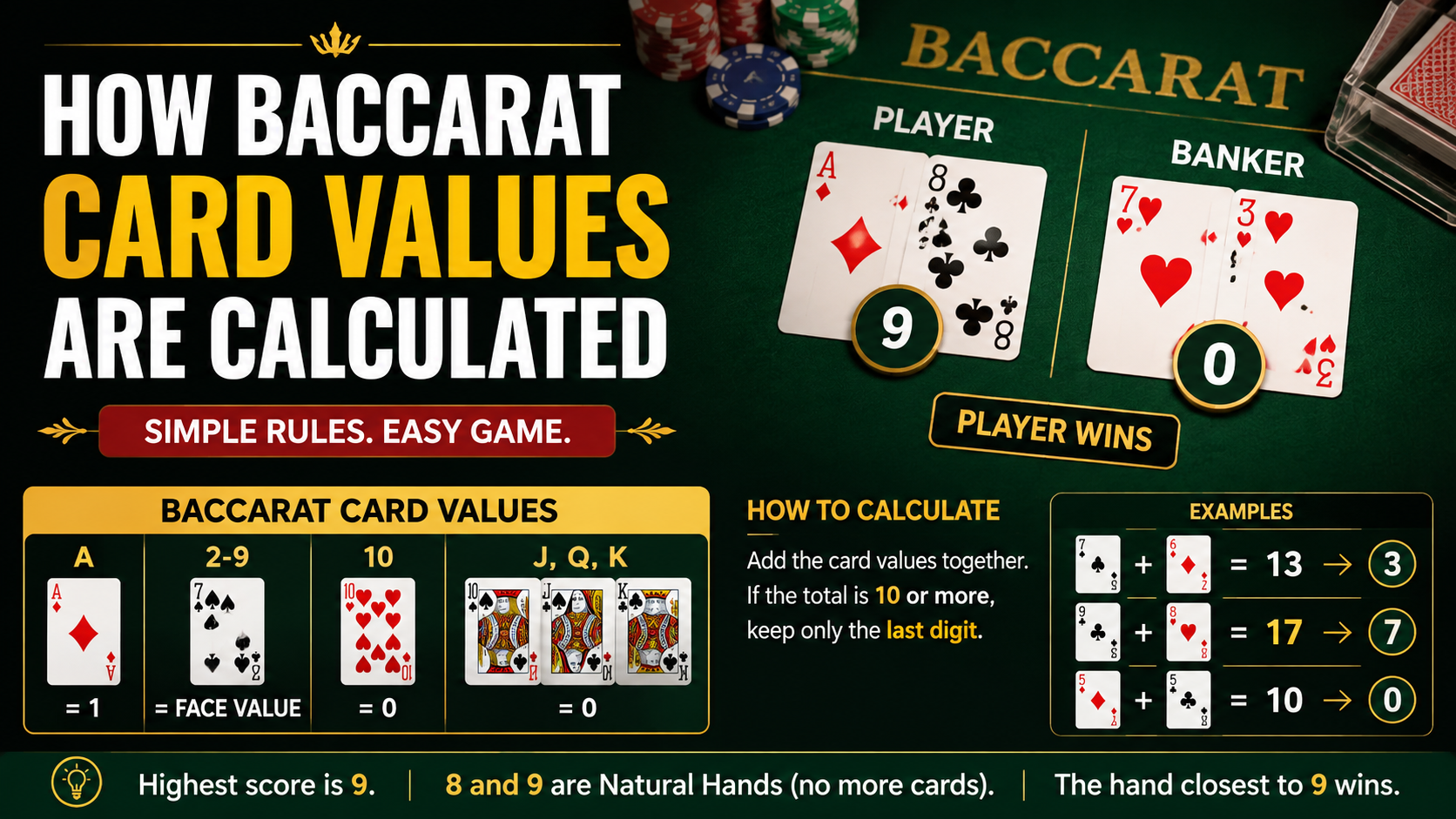
Every card in baccarat has a fixed point value. The rules are straightforward:
- Ace = 1 point
- Cards 2 to 9 = Face value
- 10 = 0 points
- Jack = 0 points
- Queen = 0 points
- King = 0 points
The suit of the card does not matter. A 7 of hearts and a 7 of spades both have the same value of seven.
Official baccarat rules also use this scoring system: cards from 2 through 9 retain their face value, Aces count as one, and 10s and face cards count as zero.
For beginners, the easiest thing to remember is this: in baccarat, high-looking cards are not always high-value cards. A King may look powerful, but it contributes zero points to the hand.
The Simple Rule for Calculating a Baccarat Hand
After assigning a value to each card, add the points together.
If the total is between 0 and 9, that number is the final hand value.
However, if the total reaches 10 or more, you drop the first digit and keep only the last digit.
For example:
- 4 + 3 = 7
- 8 + 1 = 9
- 7 + 6 = 13, so the hand value is 3
- 9 + 8 = 17, so the hand value is 7
- 5 + 5 = 10, so the hand value is 0
This is sometimes described as calculating the total modulo 10, but you do not need to understand the mathematical term to play. Just add the card values and keep the last digit whenever the total reaches two digits.
Baccarat Card Value Examples
Let’s look at a few common examples.
Example 1: Ace and 8
An Ace is worth 1, while an 8 is worth 8.
1 + 8 = 9
The hand has a value of 9, which is the highest possible baccarat score.
Example 2: King and 7
A King is worth zero.
0 + 7 = 7
The hand value is 7.
This is one reason baccarat can initially feel unusual. The King does not increase the total at all.
Example 3: 9 and 6
9 + 6 = 15
Because baccarat only keeps the last digit, the hand value is 5.
Example 4: Queen and 4
A Queen is worth zero.
0 + 4 = 4
The final score is 4.
Example 5: 6, 5, and 8
If a third card is dealt, it is included in the total.
6 + 5 + 8 = 19
The final baccarat value is 9.
This shows why a third card can completely change the result of a hand.
What Does a Score of Zero Mean in Baccarat?
A hand can have a score of zero in baccarat.
For example:
- 5 + 5 = 10 → 0
- 7 + 3 = 10 → 0
- King + Queen = 0 + 0 → 0
A score of zero is sometimes called a Baccarat hand. It does not mean the player automatically loses because the other hand may also have a low score. The winning hand is simply the one with the total closest to nine.
So, if the Player has 0 and the Banker has 4, the Banker wins. If both sides finish with the same total, the result is a Tie.
Why Are 8 and 9 Called Natural Hands?
One important baccarat rule involves Natural 8 and Natural 9.
When either the Player or Banker receives a total of 8 or 9 from the first two cards, it is known as a natural. In standard baccarat, no further cards are drawn after a natural, and the result is determined immediately.
For example:
- Player: 4 + 5 = 9
- Banker: 7 + Ace = 8
The Player wins because 9 is closer to the highest possible baccarat total.
A Natural 9 is the strongest possible two-card result, while a Natural 8 is also a very strong hand. Standard baccarat rules specify that when the initial hand totals 8 or 9, additional cards are not drawn.
How the Third Card Affects the Total
Baccarat is largely a rules-based game, meaning the decision to draw another card is generally automatic.
In standard Punto Banco baccarat:
- The Player usually draws on totals from 0 to 5.
- The Player stands on 6 or 7.
- A Natural 8 or 9 ends the drawing process.
- The Banker follows a more detailed third-card rule based on its own total and, in some situations, the Player’s third card.
You do not normally have to decide whether to take another card yourself. The dealer or online game follows the established rules automatically.
Understanding the card values first makes these third-card rules much easier to follow.
A Quick Way to Remember Baccarat Card Values
If you are new to the game, use this simple formula:
Ace = 1
2–9 = Face Value
10, J, Q, K = 0
Then add the cards.
If the answer is:
- 0–9: Keep the number.
- 10 or more: Keep only the last digit.
That is the core of baccarat scoring.
For players who want to understand the game beyond basic scoring, learning how values connect with the betting options, table rules, and game mechanics can provide a clearer overall picture. Guides covering how baccarat works can help readers become more familiar with the broader structure of the game before exploring different baccarat formats.
Common Mistakes Beginners Make
Treating Face Cards as 10
This is probably the most common mistake. In baccarat, a King, Queen, Jack, and 10 all have a value of zero.
Thinking an Ace Can Be 11
That rule belongs to blackjack, not baccarat. An Ace is always worth 1 point.
Forgetting to Drop the First Digit
A total of 14 does not mean the hand has 14 points. The score is 4.
Confusing Baccarat with Blackjack
Although both games use playing cards, the scoring systems are completely different. Baccarat has no busting and no score above 9.
For an additional rules-based reference, the Singapore Gambling Regulatory Authority’s baccarat game rules provide official information on baccarat card values and hand totals.
FAQs
What is the value of an Ace in baccarat?
An Ace is always worth 1 point in baccarat. Unlike blackjack, it cannot count as 11.
What are face cards worth in baccarat?
The Jack, Queen, and King are all worth zero points. A 10 is also worth zero.
What happens if the total is 15?
You keep only the last digit, so a total of 15 becomes 5.
What is the highest possible baccarat score?
The highest possible score is 9. A two-card total of 8 or 9 is known as a natural.
Does the suit of a card matter in baccarat?
No. Hearts, diamonds, clubs, and spades do not affect the value of a baccarat card.
Can a baccarat hand have a value of zero?
Yes. For example, a 5 and a 5 total 10, which becomes 0 in baccarat scoring.
Final Thought
Baccarat card values may seem unusual when you first see them, but the system is actually very easy once you remember a few basic rules. Cards from 2 to 9 keep their face value, an Ace is worth one, and 10s and face cards are worth zero. When the total reaches 10 or more, only the last digit counts.
The key is to focus on the final score between 0 and 9 rather than the full mathematical total. After following a few hands, the calculation becomes almost automatic. Understanding this foundation can make it easier to follow baccarat rounds, recognise Natural hands, and better understand how the game progresses.